Click on images to enlarge
* * * * * *
SATIRE ON
GOVERNMENT CORRUPTION
By Jose A. Quirino
Philippines Free Press, Manila, August 29, 1959
The First
Movie Commentary On Philippine Political life And Mores, “Juan Tamad Goes To
Congress” Takes Pot Shots At Influence Peddlers, Grafters, Congressional
Shenanigans, And Even The White Paper.
Will This Wacky But Hard-Hitting Film Offend Certain Politicos?
HOT
as today’s headlines is a frivolous and wacky movie that takes pot shots at
congressional shenanigans, the Bureau of Internal Revenue, the Central Bank,
the 40 percent tax on foreign exchange, ten percenters, influence peddlers, and
even the White Paper.
“Juan
Tamad Goes To Congress” is the first political satire of Philippine
cinema. Based on an original story by
Congressman Pedro A. Venida of Camarines Norte (Nacionalista), who made a name
for himself as a wit through his “Nothing” and “Something” speeches in
Congress, the film is set in pre-Hispanic times. But the picture is pre-Hispanic only as far
as musical scoring and costumes are concerned.
It is full of modernisms – racy and jazzed-up dialogue; references to
“press conferences” and “influence peddlers”; practices of modern politicos
(like kissing babies and jumping over fences and canals); and a streamlined,
fish-tailed carabao-drawn sled a la Cadillac with the familiar No. 8 plate.
The
picture’s foreword sets the mood for nonsense:
“The story we are about to tell you is based on facts. Any similarity to actual persons and events
is intentional. In fact, carefully
planned. If there should be any
resemblance to any person – living, dead or missing, conscious, unconscious or
still campaigning – that’s just too bad.”
Congressman
Venida, the photoplay’s author, explains the serious message behind the
wackiness. “We have tried to cure the
ills of our political system through sincere, honest and orthodox methods but
we have obtained no results. So we
resort to ridicule through this picture.
If we cannot work it out, we can laugh it off.”
Incidentally,
Venida believes that the funniest things are not well-rehearsed jokes but
real-life faux pax, like the
fumblings and bumbling of congressmen.
The
film’s smart-alecky dialogues (an effective combination of Tagalog and English
is supercharged with uproarious gags that twit present-day politics and
politicians. “We have the best
politicians that money can buy”…”The trouble with third parties is that they
usually come out third in the counting of ballots”…”To be a good politician,
you must first be a good actor. To be a
senator would be a breeze after that.”
Aside
from being a satire on graft and corruption and political ______, the film is
also an indictment of the indolence of the Filipinos, which Rizal, too, bewailed. Juan Tamad or Lazy John, the main character,
is a lovable but indolent scoundrel who typifies the shiftless and footloose
among us. Juan’s tragedy is our tragedy. Juan, like many of us, is lazy only
physically. His brain works endlessly,
thinking up contraptions to lessen his daily load. He has a fatalistic but none the less
cockeyed philosophy: “Everything in life
is predestined. Ergo, why should I work
to attain what is already mine by destiny?”
This carefree outlook impels this lovable folklore character to wait
under the guava tree for the fruits to fall into his mouth.
Censorship?
One
of the costliest productions hereabouts (the picture reportedly cost P275,000,
with a top business executive footing the bill). “Juan Tamad Goes To Congress,” which was
filmed in Eastman color and has a cast of 3,000, is the first local picture
that shows the different scenic wonders of the Philippines – the Pagsanjan
Falls in Laguna, the beautiful Mayon Volcano with its peerless cone,
breathtaking Tagaytay Ridge, the colorful Hundred Islands of Pangasinan, the
waterfall of Magdapio, the Magat River of Nueva Vizcaya, and the Ifugao rice
terraces of Mountain Province, dubbed the eighth wonder of the world.
Conceived
as early as two years ago by Congressman Venida, the story was converted into a
photoplay through the combined talents of rugged individualists like Carlos V.
Francisco, the country’s top muralist, who acted as production designer and
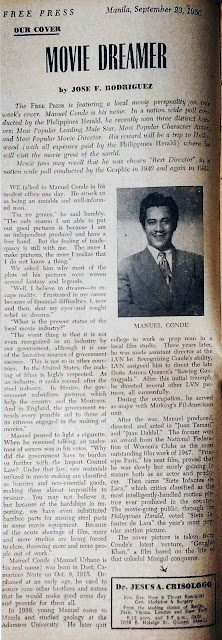
setting director, musical director Ariston Avelino, Manuel Conde, producer and
director, who also portrayed the title role, and Jess Banguis,
scriptwriter. Lending color to the
picture is the Barangay dance troupe, the aggrupation that accompanied the
presidential yacht Lapu-Lapu in its
cultural and industrial tour of Southeast Asia.
When
we voiced the fear that a considerable portion of the film may end up in the
scissors department of the Board of Review for Moving Pictures because of its
controversial nature, Conde declared with asperity: “Why?
The main purpose of the picture is to entertain. There is nothing immoral in the film. Neither does it violate any rule of
censorship. Those who inject meanings
into the dialogue and situations in the photoplay do so at their own
risk.” The target showing date of the
picture, which was recently completed, is September 15. Conde says negotiations are on for its
exhibition at a big downtown theater.


One
of the controversial aspects of the photoplay is the fact that many of the
characters look like some of the country’s top government officials and
powerful politicians. Sultan Maputim, a
good but weak-kneed chieftain surrounded by grafting sub-alterns and advisers,
for instance, is portrayed by Flaviano Miranda, who is a deadringer for
President Garcia. Extending the odious
comparison further, Maputim is depicted in the picture as being fond of sungka, an ancient Filipino game
slightly resembling chess, the President’s favorite pastime.
A
hilarious but meaningful sequence shows Sultan Maputim playing sungka with Congressman Juan Tamad. The sultan tells Lazy John: “I enjoy playing sungka with you because you never ask for favors, unlike others who
use the game as an excuse to ask patronage from me.”
Another
uproarious but hard-hitting sequence shows Juan indulging in a bit of
legerdemain by producing food out of nowhere.
He utters the magic words: “BIR,
CB, VIP, tax.” Asked to explain the
initials, he says: “Bigay ikaw regalo
(BIR), Camote bodega (CB), and verified influence peddler (VIP).” (Bigay ikaw regalo means “You give me
presents.”) Queried further where he
learned the magic words, Juan gladly obliges:
“From the White Paper.”
Shenanigans
The
story revolves at a fast pace around Juan Tamad, the indolent son of a couple
who are the sultan’s official oil makers.
His laziness prompts Juan to borrow money from the village folk. In time, these creditors form a delegation
which calls on Juan’s parents to ask them to persuade Lazybones to run for
Congress. Only by winning a
congressional seat can Juan pay his debts, his creditors believe.
Juan
agrees to run and this is where the fun begins.
He is provided with campaign trainers, a couple of political lameducks
ably portrayed by Joseph de Cordova and
Miniong Alvarez. As Lamy Ducky, Alvarez,
who is cross-eyed, is a perennial loser, although his protégés win at the
polls. This serves to underscore the
Filipino’s flippant observation: “Ang
taong duling walang gawang magaling.”
(“A cross-eyed man is good for nothing.”)
Juan’s
trainers teach him how to kiss babies, how to jump over fences and canals, how
to shake hands and pat backs. Although
he has powerful opponents in Lakan Hangin (hot air), a pompous and unscrupulous
politico, and Lakan Tabil, a loquacious third-party candidate who would sell
his grandmother down the river if this would make him win, Juan emerges
victorious because of his gimmicks (kissing babies, etc.).
At
the outset, Juan is flummoxed because,
although he hears his colleagues in Congress address one another as “the
gentleman from so-and-so,” they indulge in fisticuffs at the slightest
provocation. For instance, during one
session, the gentleman from Boradod was explaining the mystery of the dry artesian
wells: “I only promised artesian wells. I did not promise water.” Another congressman rose to interpellate but
the first gentleman told him to shut up.
The two then converted the august halls of Congress into an arena.
The
gentleman from Kakawati wanted to find out from the Speaker if the foreign
affairs department was engaged in the free delivery service “because the
diplomatic bayong” – vernacular for
pouch – “is being used to transport all sorts of items, from pins to
jewelries.”
Somebody
questioned one legislator why he was asking for so much funds to build bridges
when there were not rivers in his district.
This was his bright answer: “That
is public service. The best remedy for
unemployment is to build the bridges first, then dig the river afterwards.”
Even the Board of Pardons and the Bureau of
Customs get hit during the sessions attended by Juan, who is known as the
“Gentleman from Lawang-Lawa” for the simple reason that his bailiwick is
bankrupt.
The
congressman from Sibacong interpellated the gentleman from Kakawati thus: “Please pardon me for interrupting…” The Kakawati solon cut him short thus: “I am sorry but I cannot pardon you because I
am a member of the pardon board.”
Another
legislator wanted to know from the Lismabi – slang for “mabilis” or “fast” –
solon if the 200 transistors he brought in from Hong Kong were tax paid. He countered indignantly: “Why should I pay for my personal effects?” Turning to Juan, the Lismabi congressman
winked knowingly: “You know, Juan. As long as you are a gentleman, you can bring
into the country anything from your junkets abroad tax free as personal
effects.”
The
highlight of the congressional proceedings is the adjournment of the session by
the Speaker who bangs the gavel: “Resume
at Bayside” (a night club).
Longest Speech
After
four years of doing nothing in Congress, Juan returns to his village in grand
style – aboard a palanquin, surrounded by beautiful girls, and preceded by a
blaring brass band. Because he obviously
enriched himself in office while his constituents suffered in poverty, Juan was
mobbed by the village folk.
Later,
a repentant Juan holds a meeting and delivers the longest speech in his life
(this is also the longest speech delivered before the cameras in local movie
history). He tells his hushed audience
that he is not interested in politics any more.
In
one of the few serious moments in the picture, Lazy John twits the voters for
electing to office people who later become their masters instead of their
servants. “If there are bad officials
today,” he points out, “it is the fault of the voters because they make
politicians contribute to all sorts of affairs:
christening parties, weddings, funerals, and fiestas. By doing this, you sell your votes. The politicians then think of ways to get
back their capital. Not all politicians
are crooks but many of them are, including myself. As long as the ballot is within the commerce
of men nothing is going to change.”
The tragicomic conclusion of “Juan Tamad Goes To
Congress” shows the idler under his favorite guava tree, waiting for an
overhanging ripe fruit to fall into his mouth. The villagers form another delegation with a
new project: “Juan Tamad For Senator.”
* * * * * *




.jpg)


.jpg)

