Showing posts with label Lamberto V. Avellana. Show all posts

Thursday, May 23, 2024

Thursday, February 17, 2022

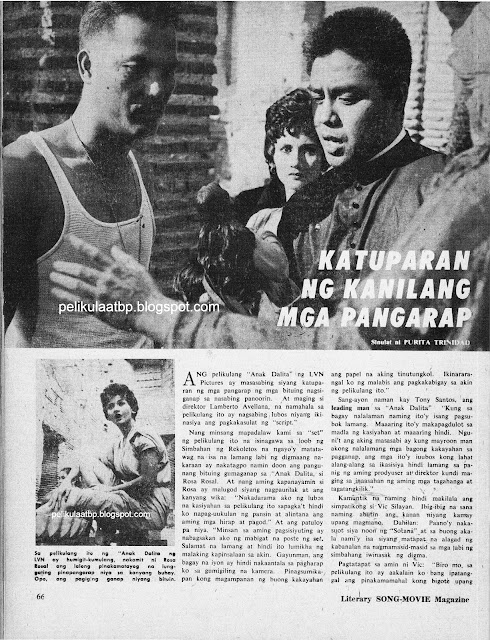
ANAK DALITA: KATUPARAN NG KANILANG MGA PANGARAP (Sinulat ni Purita Trinidad, Literary Song-Movie Magazine, March 1956)

 Click on images to enlarge


Source:  Literary Song-Movie Magazine, March 1956
(From the magazine collection courtesy of Simon Santos, Video 48)

* * * * * * *


Thursday, January 7, 2021

BADJAO (1957)

 Click on images to enlarge


Source:  Literary Song-Movie Magazine, April 1957
From the magazine collection courtesy of Simon Santos, Video 48

* * * * * * *


Sunday, September 10, 2017

ANG GINTONG SALAKOT SA NEW FRONTIER CINEMA THEATER (Tagumpay Magazine, November 16, 1966)

Click on image to enlarge
Source:  Tagumpay Magazine
November 16, 1966

* * * * * * *


Thursday, July 9, 2015

Sunday, June 14, 2015

DESTINATION: VIETNAM (Paramount Pictures, 1968)

Click on images to enlarge
 DESTINATION:  VIETNAM
Release Date:  October 1968
Productions: Arbee Productions and Uniprom, Inc.
(domestic and worldwide release by Paramount Films International)
Stars:  Amalia Fuentes, Leopoldo Salcedo, Kieu Chinh, Vic Vargas
Direction:  Lamberto V. Avellana
 

* * * * * *


Saturday, February 28, 2015

A WELCOME CHANGE (The Weekly Nation, September 10, 1965)

Click on images to enlarge


 * * * * *


A WELCOME CHANGE

Avellana’s Portrait stands out from the current crop of films mired
 in triviality, copying, and sensationalism.

By Ophelia San Juan

IN AN age of fast guns, tasteless sex, and sick humor, the advent of Lamberto V. Avellana’s film version of the lyrical, evocative, compassionate, and beautiful play by Nick Joaquin, A Portrait Of The Artist As Filipino, is a welcome change.  It is a noteworthy artistic product of men recognized as the best in their respective fields.

     Portrait is set in Intramuros – the old Manila, the original Manila, according to the author, where the erstwhile splendid townhouses of the principal families “had come down in the world” and were “no longer splendid, no longer the seats of the mighty, abandoned and forgotten, they stood decaying all along the street; dreaming of past glories, growing ever more dark and dingy and dilapidated with the years; turning into slum-tenements at last” – in the destruction and the horror it would bring, “the year of Hitler for Europe – but for us over here, it was the year of the Conga and the Boogie-Woogie, the year of practice black-outs, the year of the Bare Midriff.”

Unique Setting

     More particularly, however, Portrait is set in the stately old house of the painter Don Lorenzo Marasigan, the only house on Intramuros’s Calle Real that never became a slum-tenement, that remained as well-kept as the dignity, the individuality, and the nobility of the old artist and his two spinster daughters, Candida and Paula.  The world of the three hold-outs of Intramuros’s vanishing grandeur and regality is a world “where all’s accustomed, ceremonious,” and while “outside, the world was hurrying gaily towards destruction,” in the Marasigan house “life went on as usual; unaltered, unchanged; everything in its proper place; everything just the same today as yesterday, or last year, or a hundred years ago.”

     The play, as well as the film, dwells on the grace and the beauty of a past age, and on the drama of lives passionately caught in the harsh transition to a new one.

     A Portrait Of The Artist As Filipino, on film, has beauty, high drama, significance, originality, polish and that requisite of all art creativity, which makes of it the product of only the most intelligent and artistic men involved in the filmmaking in the Philippines today.

     It takes three, to make a film:  a writer, a producer, and a director.  All three have to share something in common, a passion for art not unlike the aching of a woman for her lover, or of a seedling for the sun, only in this instance their individual passions or daemons must be complimentary, and in harmony and consonance, to be able to create, not individual pieces but a totality of ideas, feelings, attitudes and actions.

     Such three lovers came together for Portrait, the initial film of Diadem Productions.

Celebrated Figure

     Nick Joaquin, the author, is the most celebrated figure in the Philippine literary world today.  This year’s winner of the Palanca Memorial Award for short story, who was also the recipient of a number of major literary awards and fellowships in the past, has been called “the most distinguished living Filipino writer,” “the first literary artist of the country,” and “the only Filipino writer with a real imagination – that imagination of power and depth and great metaphysical seeing – and which knows how to express itself in great language” – he has been called those by critics and other writers, among them the poet Jose Garcia Villa and the UP professor and creative writer Francisco Arcellana.

     Teodoro M. Locsin, writing the introduction to Joaquin’s Prose and Poems, says:  “No Filipino now writing matches his stories in power and beauty; their wedding of primitive emotions with sophisticated treatment is beyond the power of local practitioners of the art.  Here are the dark, instinctive drives of men and women caught in a cage of glittering words.  Here is the shapeless sub-conscious given significance and form.”

     The only play he has written so far, A Portrait Of The Artist As Filipino, is nonetheless the best Filipino play in English.  It has body, depth, meaning, scope, universality, timelessness, and, most important of all, that grandeur and loveliness of expression that comes only from Nick Joaquin – “agrifted stylist,” in the words of Manuel A. Viray.

     The English language is used as the medium of expression in the Portrait film, just as Joaquin himself used a “borrowed” language, but one he uses with felicity, beauty, and grace, to produce some of the best Filipino literary works.  In fact, not English alone is used in the film, but Spanish phrases as well may be heard being uttered by some of the main characters, specially the older ones.

     Explaining the incorporation of foreign languages other than English in Portrait, the film-makers said that our ancestors were not only bi-lingual like us, but in most instances were even quadri-lingual.  And presenting them in the film in the way they actually talked is one more step toward achieving realism, which is what the producers of Portrait aim at.

Their Record

     The producers of Portrait are the same producer-director team of Manuel de Leon and Lamberto V. Avellana that made the two best Filipino movies in the Asian Film Festival competitions:  Anak-Dalita and Badjao.  The former won the grand prize of the Festival in 1956; the latter the ad hoc prizes for best direction, best screen play, best editing, and best actor in 1957.  These same films have also been entered in non-competitive film festivals in Europe and the Americas, been exhibited in US art theaters.  They have given the Philippines its initial claim to international cinema.

     De Leon, who has been a loss to the Philippine movies industry since the shutdown of LVN, is making his first tentative comeback to film financing.  He is doing it with an eye to the big international market, reasoning that if a film can be good enough for worldwide viewing, it logically is good for the Philippine segment as well.  This should come about automatically, but De Leon is going even further and is insuring his sizable Philippine patronage by accepting Avellana’s proposal to make a film that has significance for Philippine life in addition to its universal values.

     Such a film obviously is A Portrait Of The Artist As Filipino, which is rich in the elements of Philippine cultural heritage and a-glitter with the human verities.

Manny de Leon

     A well-educated, well-brought up young man, Manny de Leon can be expected to favor the production of films that would not be an insult to the intelligence of its audience and a slap in the face of common decency.

     As an astute businessman, he must also know that the doubtful appeal of mediocre films will not be for the greater part of the population, nor for long.

     He also knows that his producer-friends in the Federation of Motion Picture Producers in Asia, the organization that sponsors the annual Asian Film Festival, regard him as a serious and responsible producer.  And it would be unworthy of him to make, as his comeback picture, anything less than the excellence promised by the basic material of Joaquin’s play.

     He knows, too from the experience of Anak-Dalita and Badjao, if not also from his intimate discussions of the problems of Filipino films with Avellana that only the director of the only Grand Prix-winning film of the Philippines would be suitable for the direction of Portrait.

Avellana Is Best Qualified

     In the first place, the Joaquin play is set in the old Intramuros, a place that Avellana became familiar with as a student at the Ateneo de Manila, when this exclusive school for boys was still located in that “ever loyal and noble city.”  The period, the years before the war, was also a familiar one with Avellana.  And the types of characters in the play are individuals whose manners of dressing and ways of talking, whose big dreams and deep-reaching problems, were nothing strange to him, since he himself had known friends and relatives with the same cultural heritage and social attitudes as the Marasigan family’s.

     This insight into Intramuros life possessed by Avellana is not unlike the insight of Joaquin’s.  It makes the film interpretation of the play easier for the film-maker.

     And, in going into the task of making Portrait into a film, Avellana has the educational background, the sophisticated understanding, to translate the elegiac play into an equally evocative film of mood, atmosphere, and pervasive sense of physical decay and moral triumph.

     Can one think of any other Filipino director with as rich an educational and creative background as Avellana’s; a director who could as properly read Joaquin, with the inner eye of experience and the outer heart of knowledge?

     Is there any other Filipino director who has proved his ability to communicate so lucidly, so articulately, and so brilliantly with foreign movie audiences, particularly with the critical ones, the movie critics and writers and directors who usually attend the international film festivals?

All Three Of Them

     Only Avellana has had pictures, of both the narrative and the documentary types, exhibited and praised at film festivals and in art theatres in the United States and Europe.

     Furthermore, since Portrait is a play written in English, and for its purpose or objective of drawing and attracting intelligent and critical audiences both local and foreign, needs to be made with English dialogue, Lamberto V. Avellana is ideal for it, since only he among all the directors in Filipino movies today, is truly capable of handling English not just fairly but with compelling authority.

     With Manuel de Leon’s resources as producer, Nick Joaquin’s creative talent as writer, and Avellana’s rich experience as director, A Portrait Of The Artist As Filipino has all the chances to emerge as the best Filipino picture ever made.

     Filipino films have reached such a nadir of deterioration that it is inevitable, as a law of nature, that a counter force or reaction should burgeon into the making of a film that will, in effect, elevate the Filipino film to a new stature of artistry richer than ever before.

     That film is easily De Leon’s presentation of the Diadem productions of Nick Joaquin’s A Portrait Of The Artist As Filipino, a film by Lamberto V. Avellana.


Source:  The Weekly Nation, September 10, 1965


* * * * * 


Sunday, March 7, 2010

OPERATION XYZ (1966)

Click images to enlarge
Operation XYZ (1966)

(Lea Productions, starring Jess Lapid, Gina Alonzo, Fred Galang, Vic Silayan, Caridad Sanchez, Max Alvarado, special performance by Miriam Jurado, directed by Lamberto V. Avellana)

Moviestar, March 1966
(Courtesy of Kathy Lindain)

* * * * * *

Friday, August 15, 2008

FOCUS ON FILIPINO DIRECTORS: LAMBERTO V. AVELLANA

 Article lifted from "Focus on Filipino Films - A Sampling, 1951-1982"

*Click images to enlarge


 * * * * * *

AVELLANA: A PORTRAIT OF THE FILIPINO DIRECTOR AS MASTER

Source: MOD Magazine Vol. VII, No. 211 September 5, 1975

LAMBERTO Avellana is probably the only living and active Filipino director who has succeeded in hanging on to nearly four decades of filmmaking. Almost alone, he stands as witness to the ups and downs of Philippine cinema, one who has seen and experienced it all, from the fumbling 30s (when sound was in its infancy) to the Golden 50s, to the corrosive 60s and on to the contemporary times. He step-into the world of celluloid when he was only 23, fresh from college (Ateneo, A.B., magna cum laude, Class ’37) and full of hopes. His first film was Sakay.

According to pioneering film critic T.D. Agcaoili, the director’s first movie marked the introduction of a truly creative Philippine cinema, employing organically in film some of the elements of modern stagecraft and dramaturgy that had been lacking in Philippine movies.

Of Avellana’s first film, which depicted the life of the famous guerilla leader of the Philippine-American war, Agcaoili has written thus: Sakay is an intelligent an disturbing film – disturbing in the sense that it presented history in a new light, the history of early Philippine guerilla warfare, of underground resistance at a time when the Americans, against whom the guerilla leader Sakay fought, were sovereign in the Philippines.”

Like the legendary character of his first venture, a rebel who refused to surrender to the new colonizers, Avellana has remained unvanquished by the oncoming forces of age and change. The interview becomes an opportunity for recollection. He points out: “I have practically been in and out of the scene, feeling a little conquered now and then, but always I have managed to penetrate every group of directors for every age.”

“I was the Benjamin of the first group,” he recalls, “which included Jose Nepomuceno, Icasiano, Davila, Carlos Vander Tolosa and Marvin Castro. Then came the batch of Ramon Estela, Icasiano, Manuel Silos, Gregorio Fernandez. I was also in the third group of directors, among them, Manuel Conde, Susana de Guzman, Gerry de Leon, Cesar Gallardo. And then the fourth group of Felicing Constantino, Armando Garces, Conrado Conde, Tony Santos and Fred Daluz. Later came the group of Armando de Guzman and Ding de Jesus, and then Emmanuel Borlaza, Jose de Villa, Tony Cayado and Mar Torres. And now, the Brocka-Bernal-Gosiengfiao group.”

Avellana came to the cinema from the stage. His prodigious beginnings consisted of stage plays, debates, oratory and public speaking. He was president of the Ateneo Players Guild and the Debating Society. He played, among others, Edmund in King Lear and Joan in Joan of Arc.

It is, however, in the cinema that Avellana is held in critical esteem. As director, he is best known for his two widely acclaimed films made for LVN (where he spent most of his creative years): Anak Dalita (1956) and Badjao (1957). It is still debatable whether these two are Avellana’s best, since many film authorities have repeatedly called them uneven. For the record, the first is the only Filipino film to have won a Grand Prix for Best Picture at the Asian Film Festival; the second won prized for best direction, screenplay (Rolf Bayer), cinematography (Mike Accion), and editing (Gregorio Carballo), in the same festival of the following year. From FAMAS, he received the awards for best director for his two films 10 years apart: Huk Sa Bagong Pamumuhay (1953) and Scout Rangers (1964).

When asked to choose his most satisfying works, Avellana would mention different films. His favorites, his meatier, as he puts it, are: In Despair, Kundiman Ng Lahi, Medalyong Perlas and Welga.

He justifies, “In Despair is the touching story of Asuncion, the musician who actually wrote the composition “In Despair:” Kundiman…, to me, has the semblance of contemporary life; besides I really wanted to do it. Medalyong Perlas and Welga are memorable for their narrative structures and the fine performances of the actors. Portrait Of The Artist As Filipino is also a personal favorite because it has great performances from the whole cast, and the story is set in a forbidding period of nostalgia.”

When Portrait…. (and for that matter, other quality pictures) failed to break even at the box office, Avellana started to equate the prevailing state of local cinema with the pedestrian interests of the movie audience. He then concluded that to make a money-making film, a director or producer must cater to the tastes of the masses, the sentimental audience who go to the movies with their market baskets, in their slippers or bakyas.

“Bakya”, he explains, “was never intended as a pejorative term; in fact, it was used as the gauge of a successful picture, you know, the sounds of wooden clogs in the lobby worn by the lola and the rest of her family.”

After quitting temporarily from feature films, Avellana turned his efforts to documentary. At present, he is the president and executive producer of Documentary, Inc., assisted by his sons Jose Mari and Lamberto Jr., and daughter Marivi, who are all, in their own right, distinguished stage thespians. This firm offers services from script to screen, producing, besides documentaries, newsreels, TV shorts, commercials and industrial films.

For his total contribution to Philippine cinema, he was conferred the following recognitions: FAMAS International Prestige Awards for Anak Dalita, Badjao, El Legado and La Campana de Baler; the Santiago Memorial Award in 1961 for his achievements; and an Araw Ng Maynila award for film and stage direction, in 1964. In 1968, the Citizens’ Council for Mass Media (CCMM) chose Kumander Dimas as best picture.

How, then, would he describe his philosophy in filmmaking?

“I like reality in-depth. That’s probably why I never made a good Robinson Crusoe story or a good Seven Dwarfs movie. I like to see dirt in nobility – in its rawest form. I prefer my audience to sit back and identify after watching my movie: siyanga, oo nga, ano? I also like my characters to mirror human imperfections, gusot na buhok, down-to-earth dialogue, the way authentic people speak and look. And sex as the part of the film that makes its pulsate.”

On his style, he says: “I hate camera effects. I make my camera as steady as possible. Because whenever it moves, it should always be meaningful.”

On the problems of the industry: “We have moved backward because of our basically disadvantaged economic position. This deters creativity and activity. This part of the reason why I stayed away for some time. There are many constraints: absence of formal training for actors, the small market for distribution, the onerous taxes (taxes before you make a film, taxeswhile you’re making it, taxes after it’s finished, taxes after it’s shown; this is terrible).”

On the films he has directed:

“I have made all kinds of genre – dramas, musicals, action, adventures. Anak Dalita is still a commercial film although it was neo-realistic in approach for it captures the grime and the sweat and the splendor of poverty. I also like Faithful (with Lou Salvador, Jr.) and Pag-asa (with Ike Jarlego, Jr.). I consider Sa Paanan Ng Nazareno the most expressive of my style. I also recall Prinsipe Amante, the first LVN color film; Escolta was closed, and the star of the movie, Rogelio de la Rosa, was able to see it only after three successive premieres.”

Now a sexagenarian (he was born February 12, 1915), Avellana – the punctilious perfectionist, the creator of many memorable moments in film, the mentor of several of the country’s most distinguished and most successful actors and actresses (Rosa Rosal, Charito Solis, Eddie Rodriguez, Leroy Salvador, etc.) – has decided to return once more to his first real medium of personal expression – the celluloid. Having done in recent years a string of critical flops (Destination Vietnam (1969), The Evil Within (1970), Ang Bukas Ay Atin (1973), and the second episode of Fe, Esperanza, Caridad (1974) which all failed to re-establish his original stature as master of Philippine cinema, he is now considering a serious comeback this year.

“I have already lined up five films. I have finished shooting Pag-ibig Ko’y Huwag Mong Sukatin with Boots Anson-Roa and Dante Rivero for Lea. A love story, it’s so simple it’s almost religious. I am now at work on Kapitan Kulas with Ramon Revilla and Elizabeth Oropesa for the Metro Manila Filmfest in September. It’s also similar to Sakay since the material is about Nicolas Incallado, an unknown revolutionary. Maybe, after this, I will consider doing two pictures for Oropesa whom incidentally I discovered as a child in Bus To Bataan. They are tentatively called Kay Lakas Ng Ulan and Yapusin Mo Ako. The National Media Production Center has also asked me to direct Bessang Pass. Then, I’ll probably go into a big co-production with a foreign studio; it’s called Naked In The Sun.”

Will his comeback pictures restore the glory that was Lamberto Avellana? Like all suspended judgments, the finished films have yet to be seen.

* * * * * * THE FILMS OF LAMBERTO V. AVELLANA *Click images to enlarge *Thanks to Simon Santos of video48.blogspot.com for some movie ads.